
📑
GST & Regulatory Compliance
Automated tax calculations, structured invoicing, and audit-ready reporting aligned with Indian regulations.
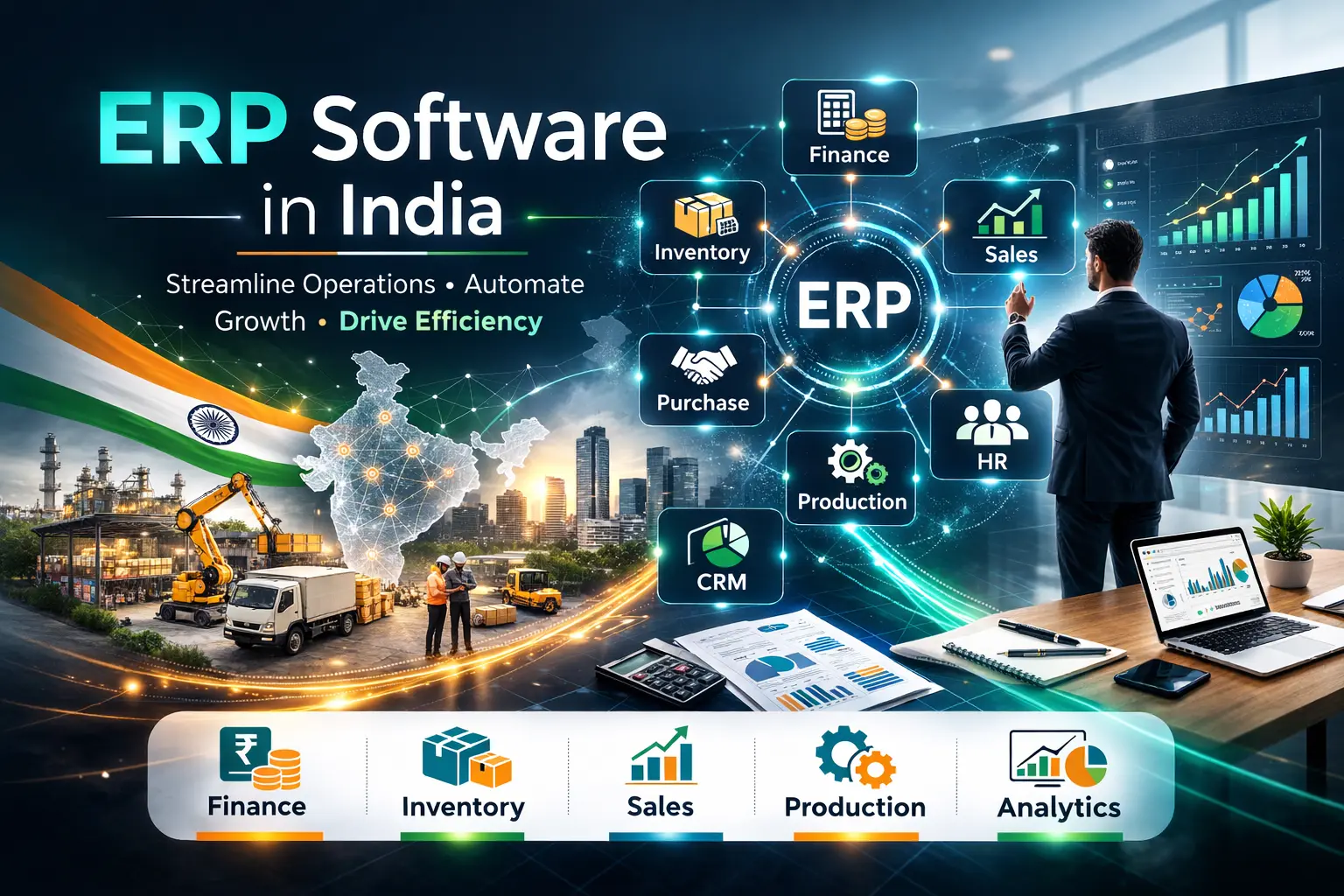
A comprehensive enterprise guide to understanding ERP systems, their role in modern Indian businesses, and why structured ERP platforms are replacing spreadsheets and fragmented software.
Automated tax calculations, structured invoicing, and audit-ready reporting aligned with Indian regulations.
Centralized control across multiple offices, warehouses, and operational units.
Instant access to financial, inventory, and operational data for faster decision-making.
Reduced manual errors and structured workflows across departments.
Accurate stock management across warehouses, batches, and locations.
Systems designed to expand with transaction volume and operational scale.
ERP (Enterprise Resource Planning) is a centralized business management system that connects finance, inventory, sales, procurement, production, and reporting into one structured digital platform.
Traditionally, Indian businesses operated using spreadsheets, manual registers, or standalone accounting tools. While functional at small scale, these fragmented systems create duplication, errors, limited visibility, and compliance risks as operations grow.
ERP replaces disconnected processes with synchronized workflows, a shared database, and real-time reporting — enabling structured growth, transparency, and regulatory alignment.
All transactions — financial, inventory, sales or production — operate from one synchronized database.
Approvals, billing, stock updates and reporting follow defined processes instead of manual coordination.
Management gains instant insight into profitability, stock position and operational performance.
ERP systems are designed to handle increasing transaction volume, additional branches, and process complexity.
ERP systems provide comprehensive coverage across finance, operations, compliance and long-term business scalability.
Accounting, GST compliance, reconciliation, cost tracking and financial transparency.
Stock management, purchase workflows, vendor coordination and warehouse visibility.
Production modules, job work, CRM, approvals and workflow automation.
Audit logs, user access controls, regulatory alignment and reporting accuracy.
Tangible improvements in visibility, control, and structured growth readiness.
Clean masters and reliable reporting that leadership can confidently rely on.
Reduced manual effort and streamlined billing, procurement and reconciliation processes.
Role-based access and approval systems enhance internal discipline.
Expand users, modules and branches without operational disruption.
Structured processes reduce dependency on individuals and manual oversight.
As Indian businesses scale, spreadsheet-driven operations introduce risk, duplication and limited visibility.
ERP replaces isolated files and disconnected accounting tools with structured workflows, centralized data, and compliance-ready reporting. This shift enables accuracy, accountability, and long-term scalability.
Multiple files, duplication risk and no centralized control.
Limited integration with inventory, production or CRM.
All departments connected through one structured system.
Improved accuracy, transparency and scalability.
A structural comparison across key operational parameters.
ERP systems are essential wherever operational complexity, compliance, and scale intersect.
BOM management, production planning, raw material tracking, job work control and cost visibility across units.
Real-time stock updates, POS integration, centralized pricing and branch-level reporting.
Purchase workflows, warehouse management, vendor coordination , logistics visibility, Sales tracking and Integrated Finance.
Batch tracking, compliance documentation, formulation control and regulatory alignment.
High transaction volume handling, distributor tracking and demand forecasting.
Manage customer relationships, service contracts, field operations, billing, and business performance.
ERP pricing is not a fixed number — it reflects business size, operational complexity, deployment model, and long-term scalability goals.
Monthly or annual pricing based on number of users and modules. Lower upfront investment, ideal for growing businesses seeking flexibility.
One-time licensing plus infrastructure and maintenance costs. Suitable for organizations preferring internal server control.
Pricing varies based on workflow customization, integrations, reporting depth, and operational requirements.
Number of users, departments, and functional modules directly influence system configuration and cost.
Data transition, training, and structured deployment impact the overall ERP investment.
Annual maintenance, updates, and performance monitoring ensure long-term reliability and scalability.
Practical clarity for businesses evaluating ERP implementation.
Businesses that adopt ERP successfully do not merely digitize operations — they redefine control, accountability, and scalability across the organization.
ERP introduces disciplined workflows and centralized data, reducing dependency on manual coordination.
Real-time visibility enables informed decisions across finance, inventory, and operational departments.
Multi-branch expansion and higher transaction volume are supported without process breakdown.
Structured reporting and audit trails ensure long-term regulatory stability in the Indian environment.
Whether you are evaluating ERP for the first time or upgrading from existing systems, a structured assessment ensures clarity before implementation.
Process Transparency
Implementation Experience
Support Commitment